
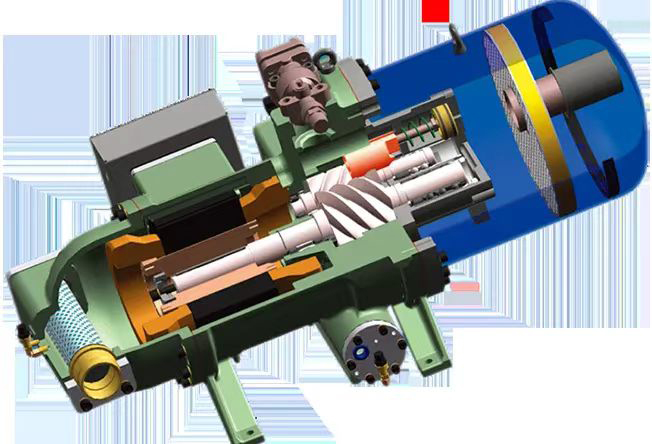
Easy to understand, the working principle of screw compressors and slide valve regulation!
Easy to understand, the working principle of screw compressors and slide valve regulation!
Screw compressors consist of a pair of parallel, meshing male and female screws and are widely used in medium to large refrigeration systems. Screw compressors are divided into single-screw and twin-screw types, with the term "screw compressor" typically referring to the twin-screw type.
Screw compressors have the following characteristics:
1. The structure of screw refrigeration compressors is simple, with fewer components and no vulnerable parts such as air valves or piston rings. The rotors, bearings, etc., have high strength and wear resistance.
2. Screw compressors feature forced gas delivery, meaning the exhaust volume is almost unaffected by exhaust pressure. They do not experience surging at low exhaust volumes and maintain high efficiency across a wide range of operating conditions.
3. Screw compressors are not very sensitive to liquid slugging and can use oil injection cooling. As a result, under the same pressure ratio, the exhaust temperature is much lower than that of piston compressors, allowing for a higher single-stage pressure ratio.
4. The use of slide valve regulation enables stepless energy adjustment. The focus of this article is to analyze the principle and process of slide valve regulation in screw compressors.
It is important to understand that the slide valve is used for stepless capacity control. After normal shutdown and restart, this component does not load. The slide valve is controlled by the microcontrol board through oil pressure, ultimately adjusting the compressor's refrigeration capacity.
By moving the slide valve left or right, the effective compression volume is increased or decreased, regulating the gas delivery volume. During loading: the piston moves left, driving the slide valve left, increasing the gas delivery volume. During unloading: the piston moves right, driving the slide valve right, decreasing the gas delivery volume.